
- Teacher: Sally Thomson
Category: Draft 22/23
Welcome to the (SCI544) Advanced Laboratory Skills for the Biomedical and Life Sciences (ALSBLS) module. On this site you will find all of the information and documentation that you require for this module. Should you need to contact me, please do so via the discussion forum (module café) or using the details provided below.
Module Leader
Dr Llinos Harris
Email: llinos.harris@wrexham.ac.uk
Introduction
To introduce students to advanced Biomedical & Life Science laboratory techniques, to develop an understanding of regulatory issues, health and safety, and the application of academic knowledge in a pathology laboratory context.


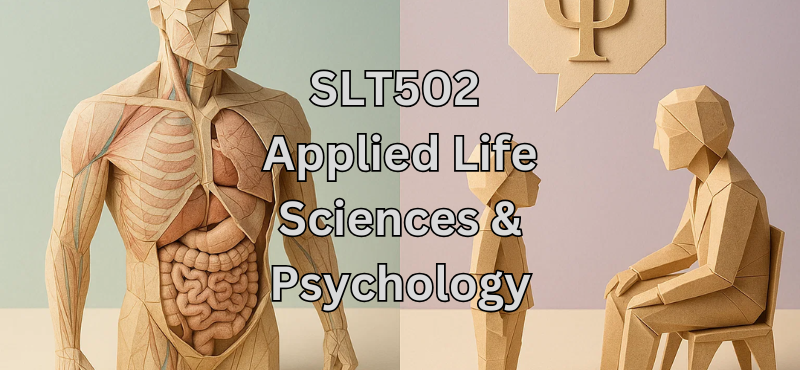
Module aims
You will build on your learning from ‘Essential Psychology’ and ‘Introduction to Life Sciences’ at Level 4 and will begin to apply these respective but related disciplines to the remit of SLT.
You will not only consider the anatomical and physiological basis for varying conditions, but you will reflect on the psychological impact and how this determines and impacts upon person led care. This will be brought to life with case-based discussions.
Assessment and intervention approaches will be considered both from a SLT perspective and that of the wider multi-disciplinary team.
Social and cultural factors to SLT practice will also be reflected upon.
You will reflect on the therapeutic relationship and your professional duty to maintain high standards even when there is resistance or are incompatibilities
Module learning outcomes
1 | Identify and explain the anatomy and physiology of the vocal tract, ear, nose and throat including typical and atypical lifespan changes.
|
2 | Identify and explain the neuroanatomy, neurophysiology and the limbic system with relevance to control of speech, language, hearing, swallowing, motivational states, emotional behaviour, learning and memory |
3 | Identify and explain key psychological theories as relevant to SLT practice. |
4 | Apply theory from anatomy, physiology and psychology to inform case management in professional practice.
|


This is one of the optional modules. It is offered in the style of an 'Open Text' module. It thus comes in topics and sub topics, with all embedding reading via hyperlinks. Depending on number of students taking the module it is supported by group or individual tutorials




This course will look at Microsoft Teams and how you can create a team with your students or even to communicate with other members of staff. Teams are not meant to replace the VLE (Moodle) but it be an additional tool to engage with your students online. It will look at how to set up a team, how to add members, how use the MeetNow feature, how to use the whiteboard and to set up break out rooms so students can engage in group work.
As Microsoft add new features, or improve existing features this course will be changed and updated to give you the latest in new features which will be useful to teaching your students online. Feel free to use it for reference and guidance at anytime during the next couple of academic years.